
Business Visibility & Platform
IDSA Marketing India LLP
Business discovery, digital identity, structured listings, inquiry paths and market-access support.
Understand this companyOne ecosystem. Nine connected areas. Local to global support.

The IDSA Ecosystem Support Network brings learning, work, business, digital access, community development and support thinking into one connected public framework. This page has one purpose only: explain the nine pillars clearly, without mixing company history, office plans, partner sales programmes or internal system language.
Learn → Work → Build → Connect → Support → Grow
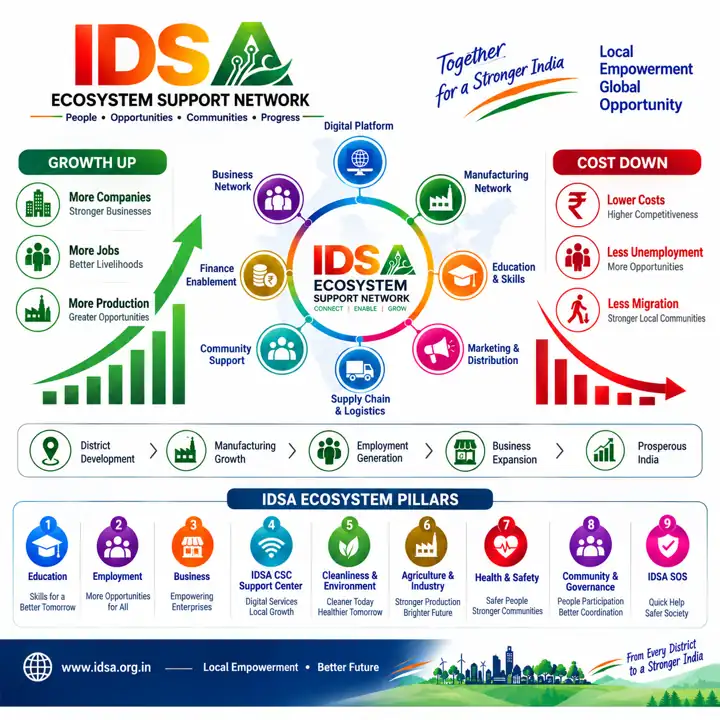
Each company has a specialised responsibility. Together they connect business visibility, retail access, food opportunity, logistics, digital infrastructure and industrial technology support without merging their legal identities or programme rules.
Business Visibility & Platform
Business discovery, digital identity, structured listings, inquiry paths and market-access support.
Understand this company
Retail & Marketplace
Retail storefront and marketplace journeys that connect eligible vendors, products and customers.
Understand this company
Food Ecosystem
Structured food-business connections for producers, processors, distributors, retailers and buyers.
Understand this company
Logistics & Movement
Movement support for products, equipment, documents and business requirements across markets.
Understand this company
Connectivity & Technology
Digital connectivity, technology adoption and practical business-enablement infrastructure.
Understand this company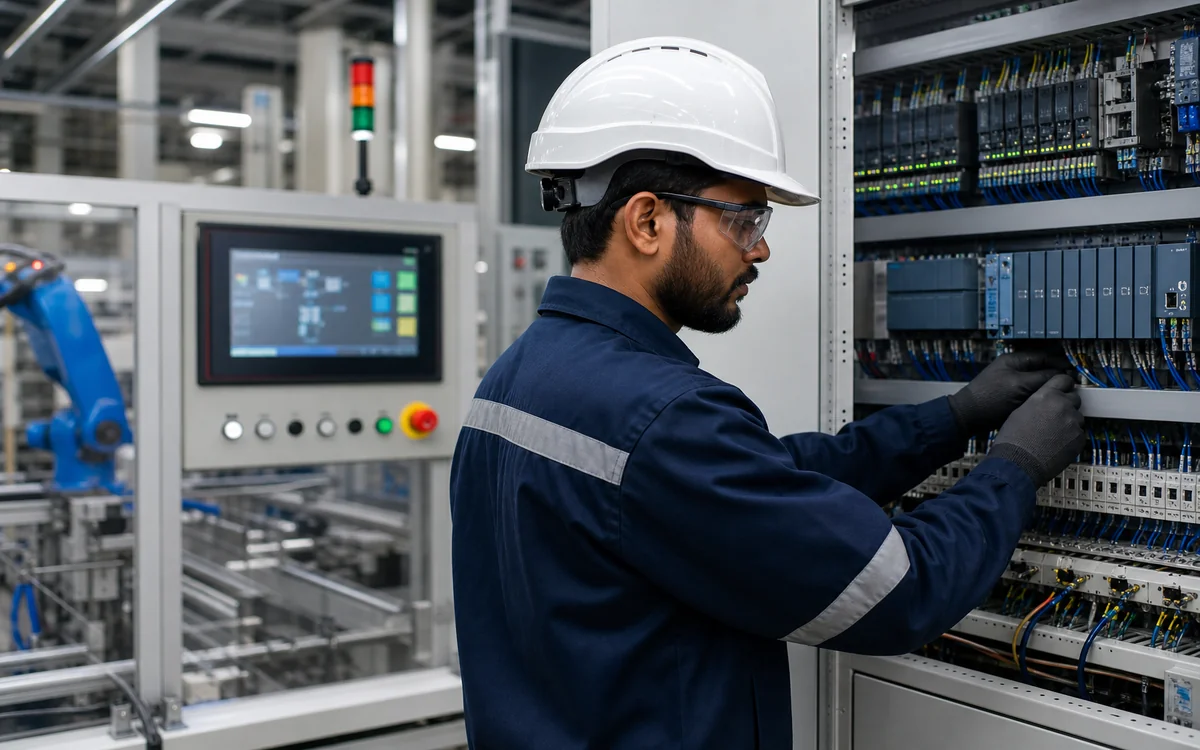
Strategic Technology Partner
Industrial automation, AC-drive and technical support context as a separate strategic partner company.
Understand this companyThese roles explain how the ecosystem connects. Company pages, eligibility, review, service availability and operating rules remain separate. No guaranteed income, orders, approval or service outcome is implied.
Scan all nine points first. Open only the pillar you want to understand in detail.
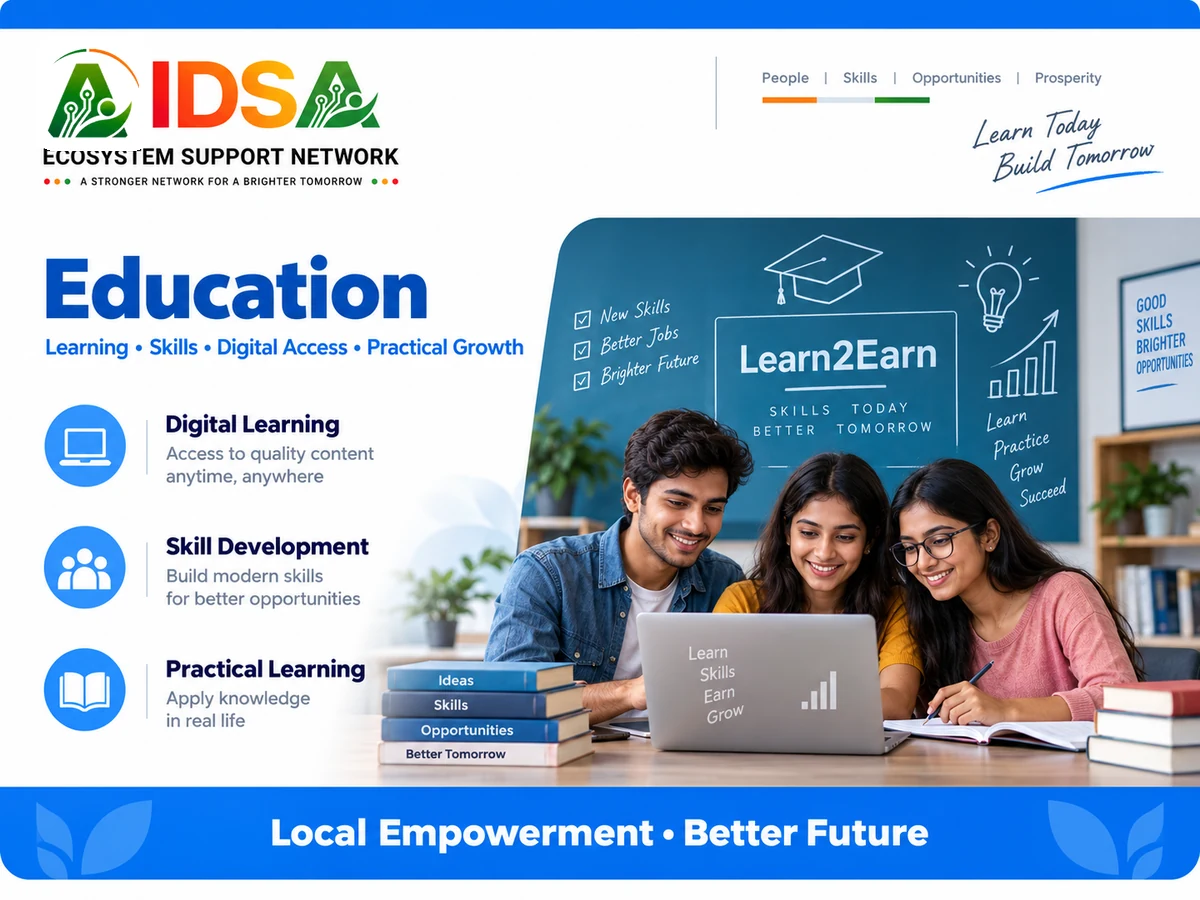
Learning • Skills • Digital Access • Practical Growth
Support useful learning, digital understanding and practical skill development so people can improve capability and explore suitable next steps.
Education in the IDSA Ecosystem Support Network is not limited to classroom study or collecting certificates. The focus is useful learning that can improve a person’s confidence, digital understanding, practical capability and ability to make better decisions. Students, job seekers, technicians, small business owners, CSC operators and working people may all need different kinds of learning, so the pillar is designed around flexible paths rather than one fixed course.
Digital access is now part of everyday life. People may need to understand online forms, digital communication, customer service, basic business tools, safe internet use, software, websites, mobile applications or work-related platforms. The Education pillar aims to make such knowledge easier to approach in plain language and, where programmes are available, connect it with guided practice instead of leaving learners with theory alone.
Practical skills matter because many people know a subject but do not yet know how to use it in real work. Project-based tasks, supervised practice, service workflows, customer communication, technical exercises and local problem-solving can help convert knowledge into usable capability. IDSA may connect learning with these kinds of activities when an approved programme has the right trainer, project, support process and operating capacity.
The pillar also supports technical and business learning. Depending on the active programme, topics may include electrical and electronics work, industrial automation awareness, digital marketing, business presentation, communication, customer handling, basic software use, service operations or entrepreneurship. The goal is not to make every learner follow the same profession; it is to help each learner identify useful skills for the path they want to explore.
Learn2Earn may be used as a project-linked learning model where a separately approved programme is actually available. Its purpose is to connect learning with practice and real project exposure. Participation in learning does not automatically create employment, income, paid projects or commercial work. Any such opportunity depends on eligibility, programme rules, real demand, review and availability at that time.
A strong local-to-global ecosystem begins when people can learn close to where they live and still understand wider digital and professional possibilities. Local support centres, online resources, community partners and approved training paths can help reduce the gap between information and practical access. The long-term direction is simple: make useful knowledge easier to reach, easier to practise and easier to connect with responsible opportunity discovery.
The Education pillar therefore follows a clear sequence: learn, practise, improve and then explore the next suitable opportunity. Some people may use the learning for employment, some for business, some for technical service and some for further study. IDSA’s role is to support a clearer pathway and honest information, not to promise a fixed outcome.
Important: Training or learning participation does not guarantee employment, income, paid projects or business results.
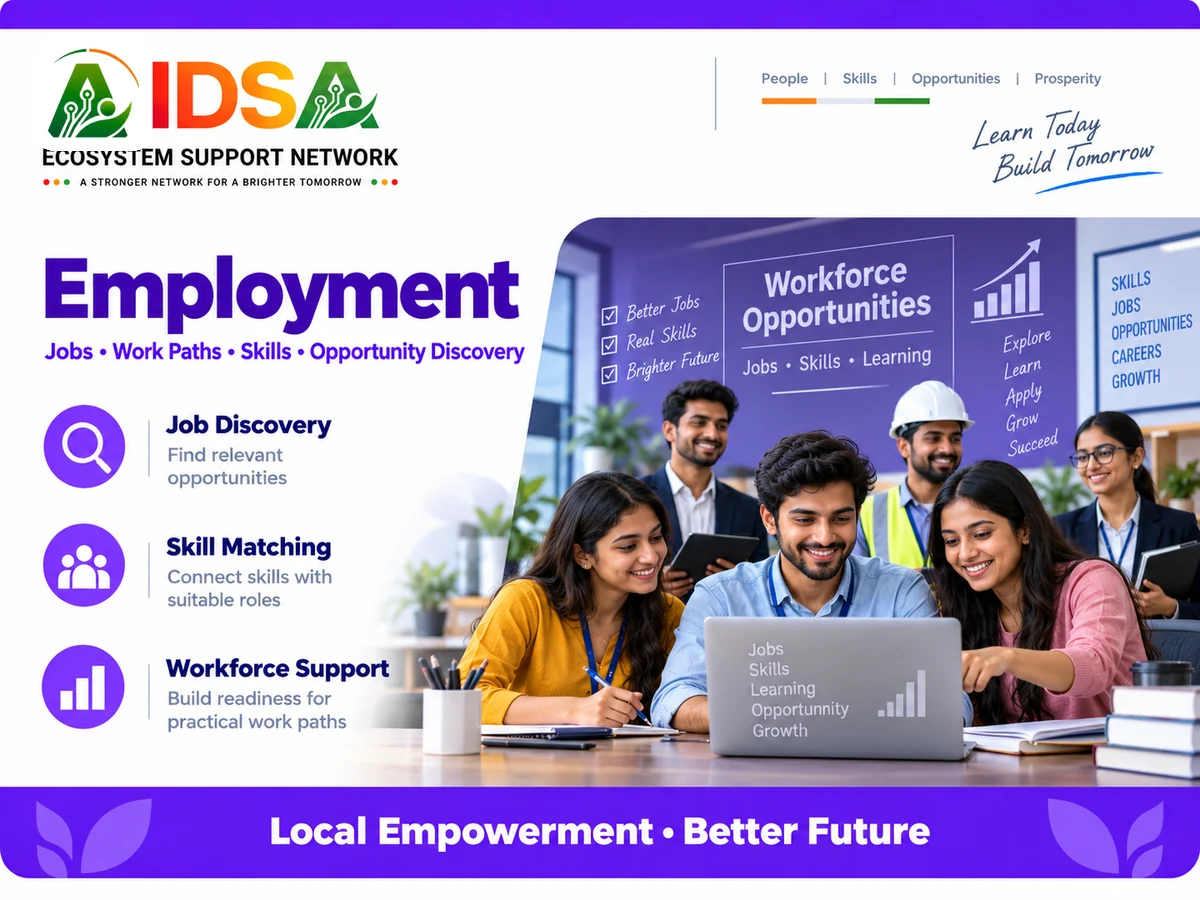
Jobs • Work Paths • Skills • Opportunity Discovery
Help people understand and discover suitable job, service, project and workforce paths without presenting discovery as guaranteed placement.
Employment is one of the most practical needs in any local ecosystem. People do not all look for the same kind of work: some want full-time jobs, some part-time work, some project assignments, some field service, and others want to use an existing trade or technical skill. The Employment pillar is designed to make these different work paths easier to understand and easier to discover through clear public information and structured application paths.
The first step is better work readiness. A person should be able to describe skills, experience, preferred location, availability and the kind of work they can realistically perform. Clear profiles and honest information help reduce mismatches between workers and employers. Where IDSA workforce or job surfaces are active, they can support structured discovery, but employers remain responsible for their own selection, role terms, workplace conditions and final hiring decisions.
Local employment can include far more than office jobs. Industrial electricians, PLC technicians, fitters, drivers, delivery workers, retail staff, service technicians, construction workers, support staff and many other categories may have different opportunity cycles. IDSA’s ecosystem approach is to keep category discovery organised so that a person can find the relevant lane without being pushed through unrelated offers or confusing internal terminology.
Skills and employment are connected, but they are not the same thing. When a person sees a gap between the work they want and the skill they currently have, the Education pillar can provide a learning direction while the Employment pillar continues to own opportunity discovery. This separation helps keep the message honest: training may improve readiness, while a real employer or project must still decide whether there is a suitable opening.
Employers also need a clear path. A business may need workers for a specific location, shift, project, service area or skill level. Structured job posts and requirement capture can make that need easier for suitable candidates to understand. IDSA does not become the employer merely by publishing or routing an opportunity, and a published opportunity should not be read as a promise that every applicant will be selected.
Good employment support also means protecting people from unrealistic claims. Salary, incentives, travel, accommodation, contract length, working hours and payment terms should come from the actual opportunity owner and should be reviewed by the applicant before accepting work. IDSA can improve discovery and coordination, but it should not invent compensation figures, promise payroll, or describe a future workforce programme as already available.
The Employment pillar therefore follows a simple direction: represent your skills honestly, discover suitable work, review the real terms, apply through the correct path and make an informed decision. Over time, stronger local workforce discovery can help businesses find needed capability and help people see more relevant work options without turning the ecosystem into a placement-guarantee scheme.
Important: IDSA supports opportunity discovery and coordination; it does not guarantee selection, salary, payroll or employment.
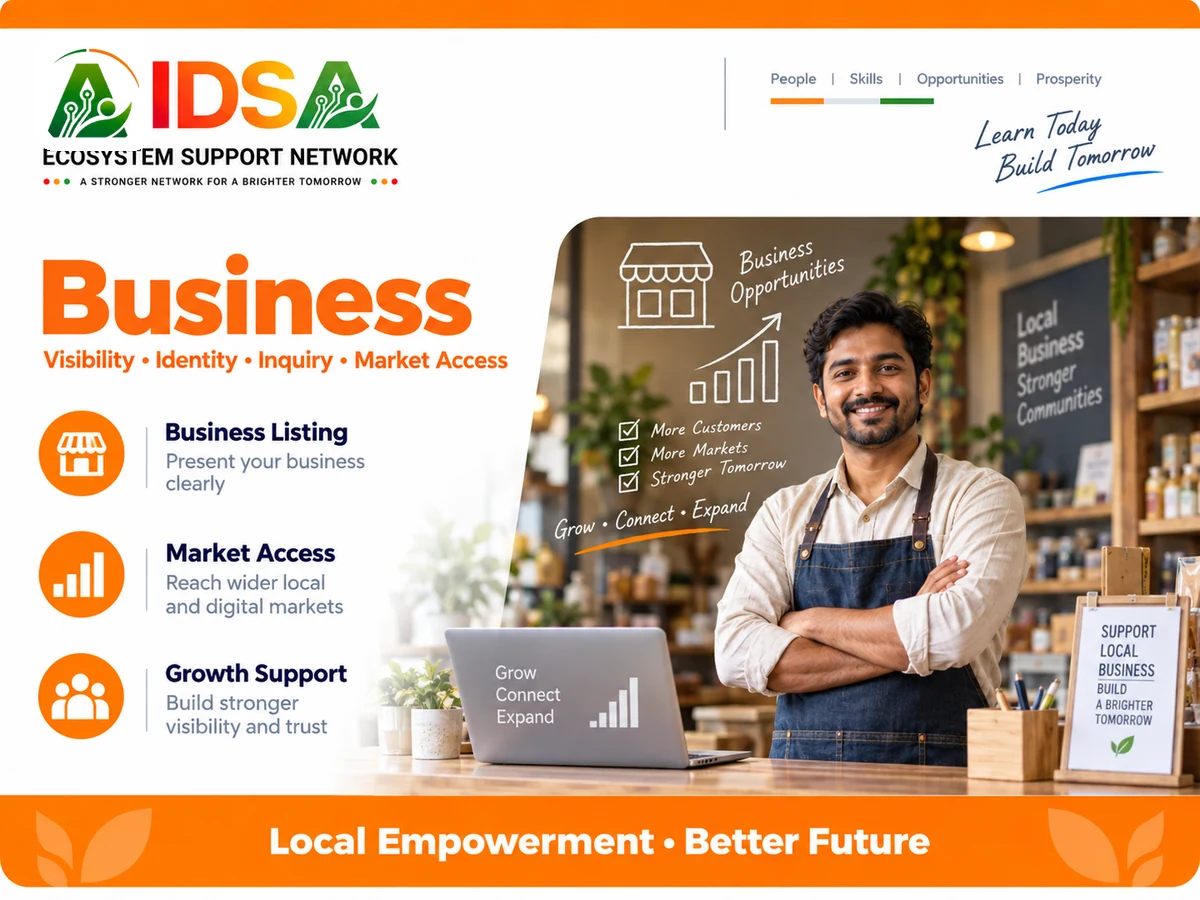
Visibility • Identity • Inquiry • Market Access
Help local businesses present themselves clearly, improve discoverability and use structured paths for inquiries and wider market connections.
The Business pillar is about helping a real business become easier to understand, easier to discover and better prepared for structured customer or B2B interaction. Many small businesses have useful products or services but their information is scattered across visiting cards, WhatsApp messages, social posts and personal contacts. A clearer business identity can bring name, location, category, services and contact context together in a more professional form.
Business visibility starts with accurate information. A listing or profile should explain what the business actually does, where it serves, how customers can reach it and what category it belongs to. Review is important because visibility without trustworthy information can create confusion. IDSA may provide directory, profile or discovery surfaces where available, but publication and presentation remain subject to the rules of the relevant product or programme.
Discovery is different from guaranteed business. A public listing can make a business easier to find, while structured inquiry paths can make customer communication more organised. Neither automatically creates sales, orders, leads or profit. Real results depend on demand, price, service quality, location, response time, competition and the business owner’s own execution. Public copy should therefore describe access and visibility honestly rather than promise commercial outcomes.
The pillar also supports connections between different types of businesses. A manufacturer may need suppliers or distributors; a retailer may need products; a service provider may need customers; a local producer may need a wider market; and an industrial buyer may need a reliable sourcing path. The ecosystem can help these parties discover the correct path while keeping each transaction, contract and commercial decision with the relevant parties.
Digital tools can make small businesses more organised. Business profiles, inquiry forms, customer communication, service categories, digital identity, structured follow-up and approved marketplace or sourcing paths can reduce scattered information. The objective is not to force every business into the same model, but to provide simple building blocks that can support growth according to business type and programme availability.
Local-to-global business development also requires honest boundaries. A local shop may only need district visibility, while a manufacturer may look for national B2B inquiries and a digital service provider may work remotely. The ecosystem should help each business understand the right next step without presenting future expansion, partner coverage or unsupported markets as already active.
The Business pillar therefore follows a practical sequence: organise the business identity, publish or present accurate information where eligible, improve discoverability, receive and respond to suitable inquiries, and build wider connections through real demand. IDSA can support the structure and discovery layer; the business owner remains responsible for products, services, commitments, pricing, delivery and customer outcomes.
Important: Business visibility and inquiry tools do not guarantee customers, leads, orders, revenue or profit.
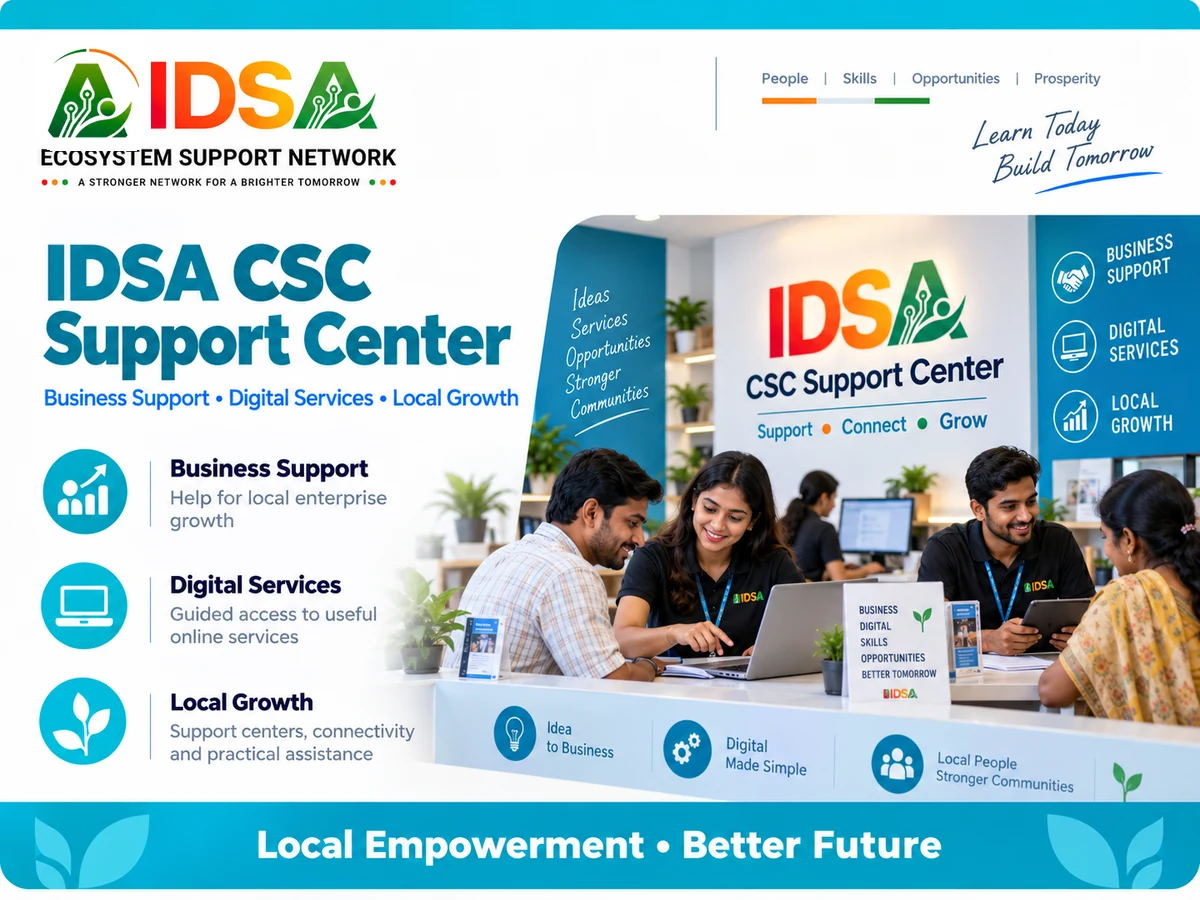
IDSA CSC Support Center • Business Support • Digital Services • Local Growth
Bring business development support, digital services and guided local assistance closer to people and businesses through IDSA CSC Support Centers and other active IDSA channels.
Digital Panchayat is the local-access pillar of the IDSA Ecosystem Support Network. Its purpose is to reduce the gap between a person who needs a digital service and the practical help required to use it. In villages and small towns, people may have a smartphone and internet access but still need guidance for forms, account setup, business information, service discovery, online communication or understanding the next step.
Local support can be provided through different channels depending on what is actually active in a location. These may include IDSA CSC Support Centers, approved local partners, digital assistance desks, connectivity services or online self-service paths. The pillar does not assume that every service is available in every village. Each programme must show its real coverage, eligibility and current operating process.
Connectivity is an important foundation. Without stable access, digital services remain difficult to use. Where an approved connectivity programme such as an IDSA AirNet-related service is active, it may contribute to the wider digital-access objective. Connectivity, however, is only one part of the pillar; digital understanding, local assistance, service quality and clear escalation paths are equally important.
Businesses also benefit from local digital support. A shop owner may need help presenting business information, a service provider may need to understand a digital inquiry, a local entrepreneur may need guidance on a public application path, and a customer may need help finding a service. A well-designed local support point should help people reach the correct existing service rather than create a second duplicate process.
The word Panchayat in this pillar describes local-community reach and a village-level support direction. It does not mean IDSA is a Gram Panchayat, government department, statutory authority or official government service provider. Government certificates, approvals, benefits and official records remain under the relevant government authority and the rules of the service being used.
Good local digital support must also protect privacy and trust. People should not be asked to share unnecessary personal data, passwords, OTPs or sensitive documents with unauthorised persons. Where identity verification is genuinely required, it must happen through the approved process for that service. Assistance should make a process clearer without weakening security or pretending that local support can bypass official requirements.
The Digital Panchayat pillar therefore follows a simple idea: bring digital access, connectivity, trusted guidance and the correct service path closer to the community. The measure of success is not the number of promises made; it is whether people can understand what is available, where to go, what information is required and what happens next.
Important: IDSA is not a Gram Panchayat, government department or statutory authority; official government services remain under their respective authorities.
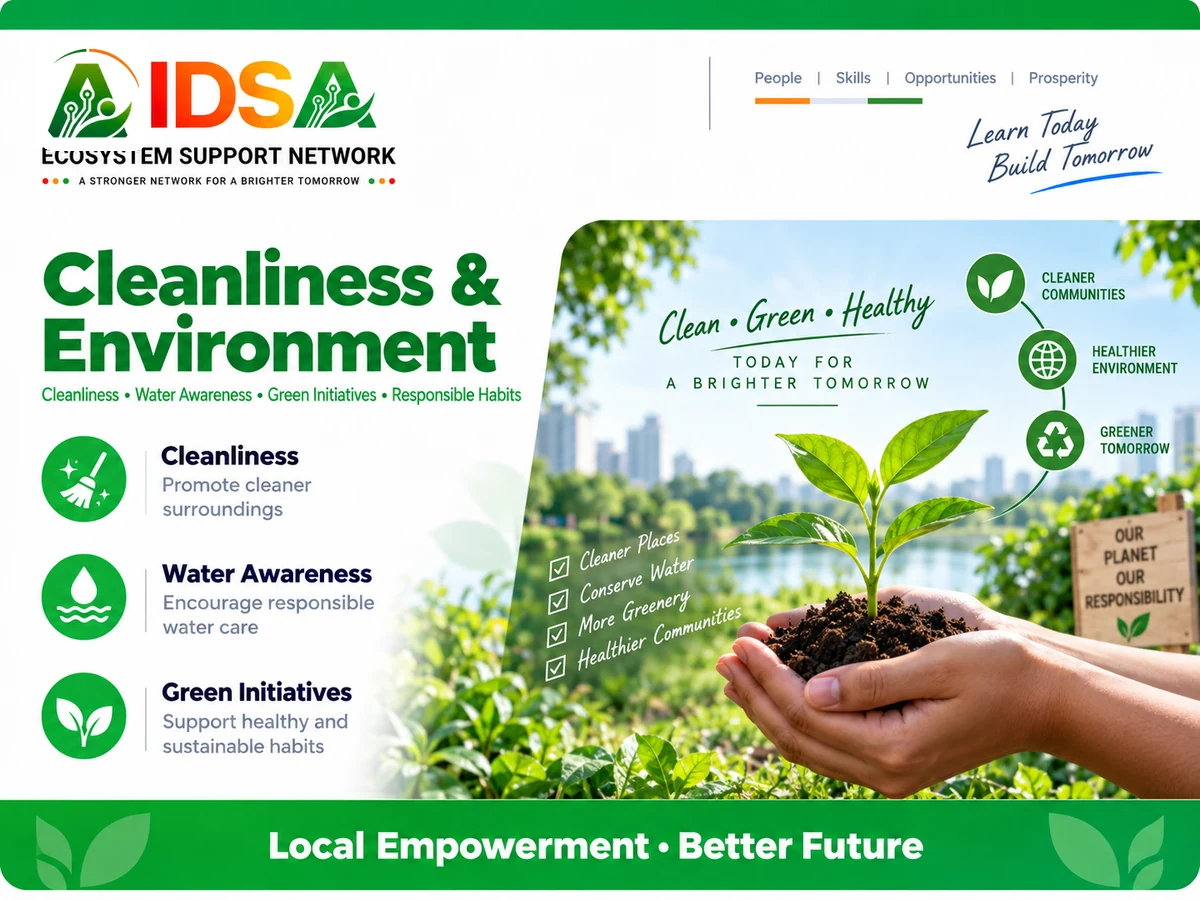
Clean Surroundings • Water • Trees • Responsible Awareness
Encourage practical awareness and community participation around cleanliness, water care, trees and responsible waste habits.
Clean surroundings and a healthy environment are shared community responsibilities. The Cleanliness & Environment pillar is designed as an awareness and participation direction within the IDSA ecosystem, not as a replacement for municipal bodies, Panchayats, pollution-control authorities or professional waste-management services. Its role is to help people understand practical actions that can be encouraged locally.
Cleanliness begins with everyday habits. Keeping public and business areas tidy, reducing litter, separating waste where local systems support it, using bins responsibly and avoiding unnecessary dumping can improve the immediate environment. Community participation becomes stronger when messages are simple, repeated through local networks and connected with actual local facilities rather than one-time campaigns with no follow-up.
Water is another important area. Communities can benefit from awareness about avoiding unnecessary water waste, reporting visible leaks to the responsible authority, protecting local water sources and understanding the importance of rainwater conservation where appropriate. IDSA can support information and community coordination, but technical water projects, testing, treatment and official supply decisions must remain with qualified providers and responsible authorities.
Trees and green spaces improve local environments, but plantation activity should be thoughtful. The right species, location, maintenance plan, land permission and long-term care matter more than simply counting planted saplings. Community groups, businesses and local programmes can support awareness and participation when the activity is permitted and there is a realistic plan to keep the plantation healthy.
Responsible waste awareness also means understanding that different waste types need different handling. Household waste, commercial waste, electronic waste, medical waste and industrial waste may be governed by different rules and service providers. The ecosystem should never encourage people to handle hazardous material without proper knowledge or authority. The public message should focus on safer habits and reaching the correct local channel.
Businesses can contribute through cleaner premises, reduced unnecessary packaging, responsible disposal practices, water and energy awareness, and support for local environmental activities. These efforts should be presented honestly, without making unsupported environmental claims or certificates. A small practical improvement that is maintained is more valuable than a large publicity claim that cannot be verified.
The pillar therefore follows a community-first direction: understand the local issue, encourage responsible habits, work with the correct authority or service provider, participate where safe and permitted, and keep the effort consistent. IDSA’s contribution is awareness, connection and organised participation—not statutory environmental enforcement.
Important: Environmental enforcement, hazardous-waste handling and official municipal services remain with qualified providers and the responsible authorities.
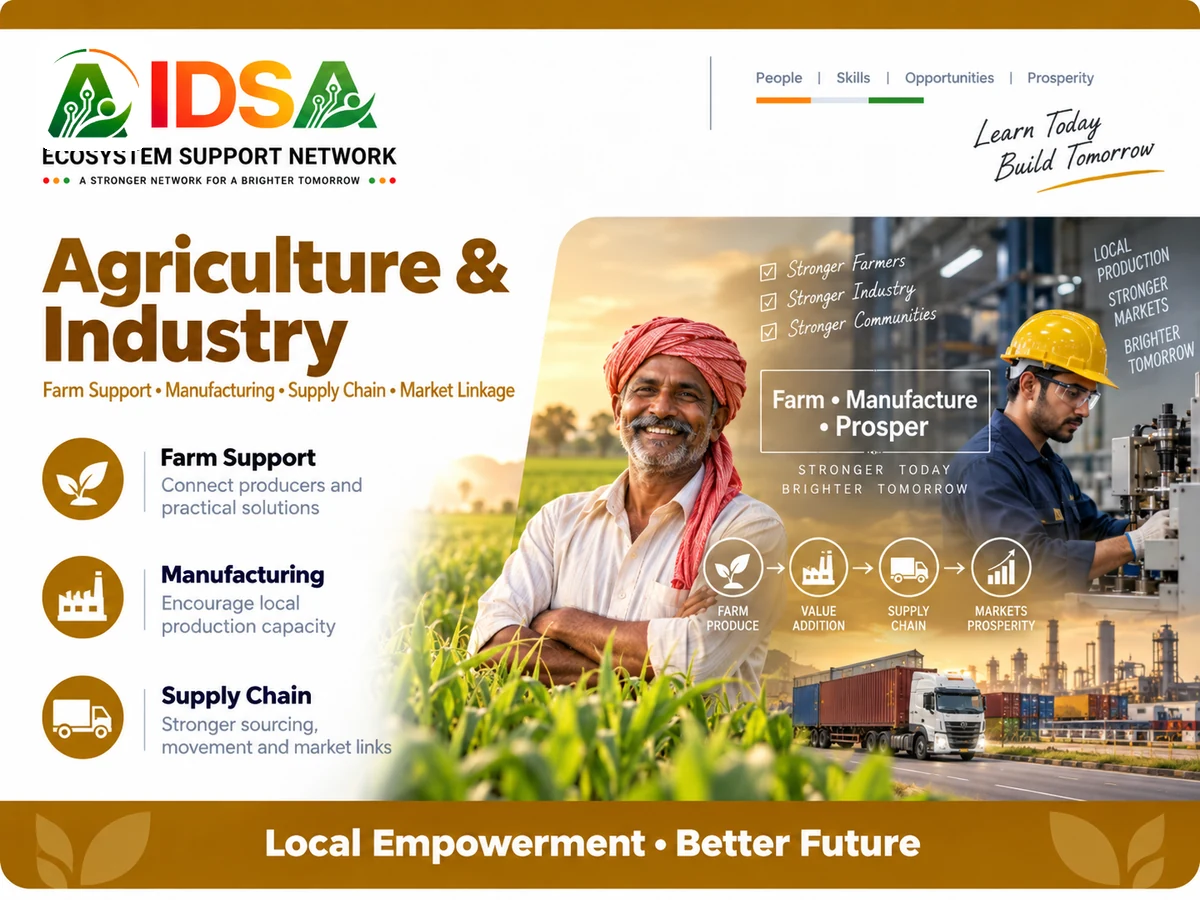
Farm • Manufacturing • Industrial Support • Market Linkage
Connect producers, manufacturers and industrial service needs with clearer sourcing, discovery and market-linkage paths where available.
Agriculture and industry are closely connected to local economic growth. Farmers and producers need buyers, inputs, services and information; manufacturers need material, machines, technicians, suppliers and markets; industrial service teams need genuine requirements and clear technical context. The Agriculture & Industry pillar brings these needs into one public direction while keeping each specialist activity under the right business and technical process.
For agriculture, the ecosystem can support discovery and market connection rather than pretending to replace agricultural departments, mandis, cooperatives, banks or expert advisory services. Local products, farm-linked processing, food businesses and distribution paths may connect through suitable business programmes when they are active. Pricing, procurement terms, quality requirements and legal compliance remain with the actual buyer, seller and applicable authority.
For manufacturing, visibility is often a major gap. Small factories, fabricators, machine shops, component suppliers and local production units may have capability that buyers outside the immediate area do not know about. Structured business profiles, manufacturing discovery and district-level market links can help make this capability easier to find without promising orders or purchase volumes.
Industrial support requires even more clarity. A breakdown case involving PLC, HMI, VFD, motors, panels, automation or electrical systems needs accurate equipment details, symptoms, urgency and location. Where India Source or an industrial inquiry path is active, it can help organise the requirement and connect it with relevant sourcing or service capability. Technical diagnosis and repair decisions must still be made by qualified professionals.
The pillar also encourages stronger local value chains. A district may have raw material, skilled workers, small manufacturers, distributors and local customers but weak coordination between them. Better discovery can help reveal these connections. Over time, local production combined with wider market access can strengthen business resilience, but each commercial relationship must develop through real demand and workable economics.
Technology can support agriculture and industry through digital catalogues, inquiry capture, service coordination, inventory visibility or communication, but technology should follow the real business process. The ecosystem should not create a second duplicate workflow for a problem already owned by a manufacturing, sourcing, directory or service path. Clear handoff is better than adding another layer.
The Agriculture & Industry pillar therefore follows a practical path: understand the producer or industrial requirement, identify the correct category, present accurate capability or need, use the relevant sourcing or discovery path, and allow qualified parties to make the commercial or technical decision. IDSA can improve connection and organisation; it does not guarantee procurement, orders, yields, repair outcomes or industrial contracts.
Important: IDSA does not guarantee procurement, farm returns, industrial orders, repair outcomes or commercial contracts.
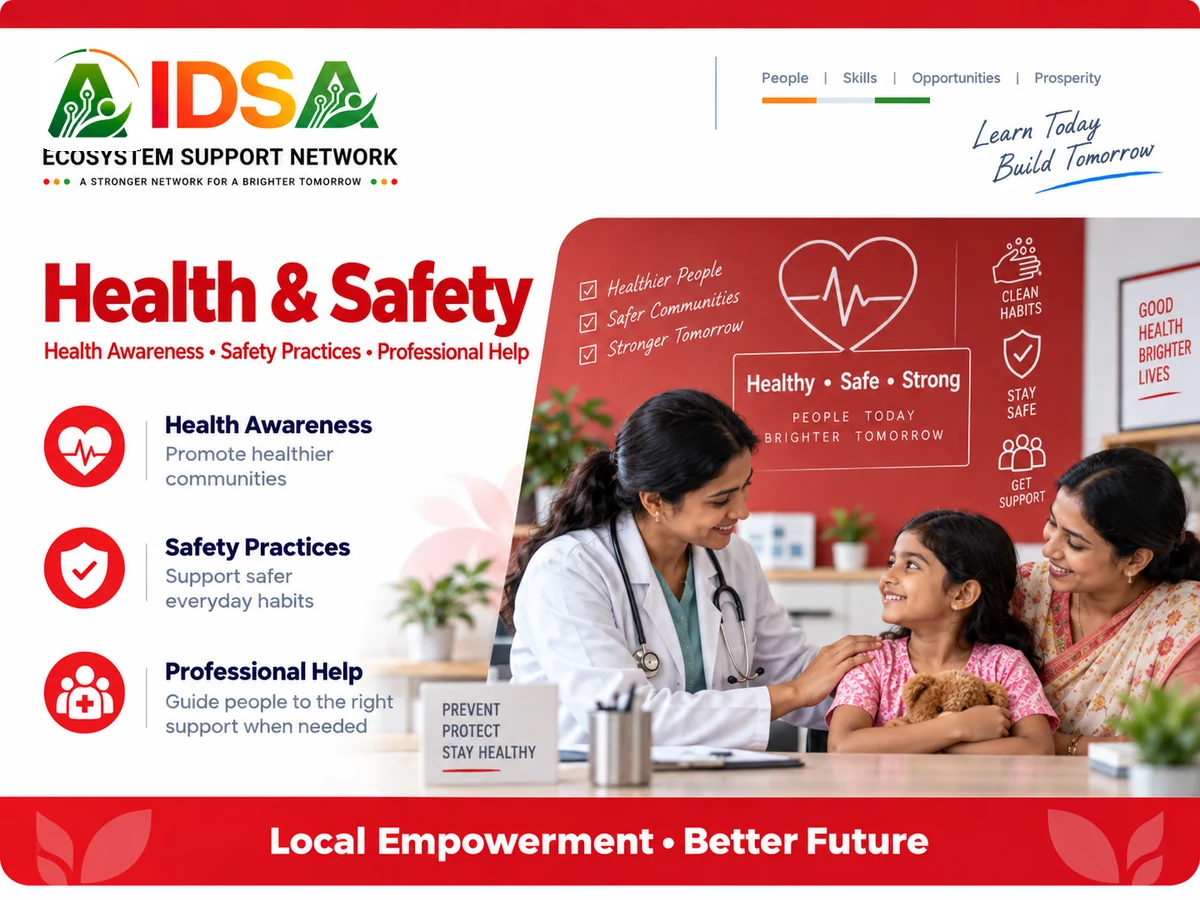
Awareness • Safe Information • Support Access • Prevention
Promote useful health and safety awareness, safer everyday practices and access to the correct professional or emergency channel when needed.
Health & Safety in the IDSA Ecosystem Support Network is an awareness and access pillar. It is intended to help people think about safer everyday practices, recognise when professional help is needed and find the correct support channel. It is not a medical diagnosis service, hospital, ambulance provider, insurance service or replacement for licensed health professionals and government emergency systems.
Health awareness can include simple, responsible information such as the importance of timely medical consultation, basic hygiene, safe drinking-water awareness, workplace wellbeing, following prescribed treatment from qualified professionals and knowing trusted local health resources. Public information should remain general and should never tell a person to ignore a doctor, stop prescribed medicine or rely on the ecosystem for a medical diagnosis.
Safety is equally broad. Homes, workplaces, roads, electrical systems, industrial environments and public spaces all have different risks. Awareness may include using suitable protective equipment, keeping emergency exits clear, following electrical and machine-safety instructions, avoiding unsafe shortcuts and reporting serious hazards to the responsible person or authority. Technical and occupational-safety decisions should be handled by qualified professionals.
For businesses and technicians, safety culture matters because pressure to finish work quickly can lead to unsafe practices. Clear work instructions, isolation procedures where applicable, correct tools, proper PPE, trained supervision and honest reporting of hazards can reduce risk. IDSA may support awareness and service discovery, but it should not issue unsupported safety certifications or claim that a workplace is safe without the required inspection authority.
People also need clear emergency boundaries. A platform message or support ticket is never a substitute for immediate emergency response. In India, life-threatening situations should use the appropriate government emergency channel, including 112. Medical emergencies should be handled through qualified emergency and healthcare services. Any IDSA support path is secondary coordination and should never delay urgent help.
Privacy is especially important in health-related contexts. Personal medical information should not be requested or shared unless it is necessary for the specific approved service and handled through an appropriate protected process. Public pages should avoid exposing sensitive health details. The ecosystem’s role is to guide people toward safer access, not to collect medical information merely because a health topic is being discussed.
The Health & Safety pillar therefore follows a cautious principle: improve awareness, encourage safer behaviour, recognise limits, reach qualified professionals early and use emergency authorities when urgent. The goal is to make useful safety thinking more visible across the ecosystem while keeping medical, legal and statutory responsibilities with the professionals and authorities who own them.
Important: This pillar does not provide medical diagnosis or emergency response. For life-threatening emergencies in India, use 112 and qualified emergency services immediately.
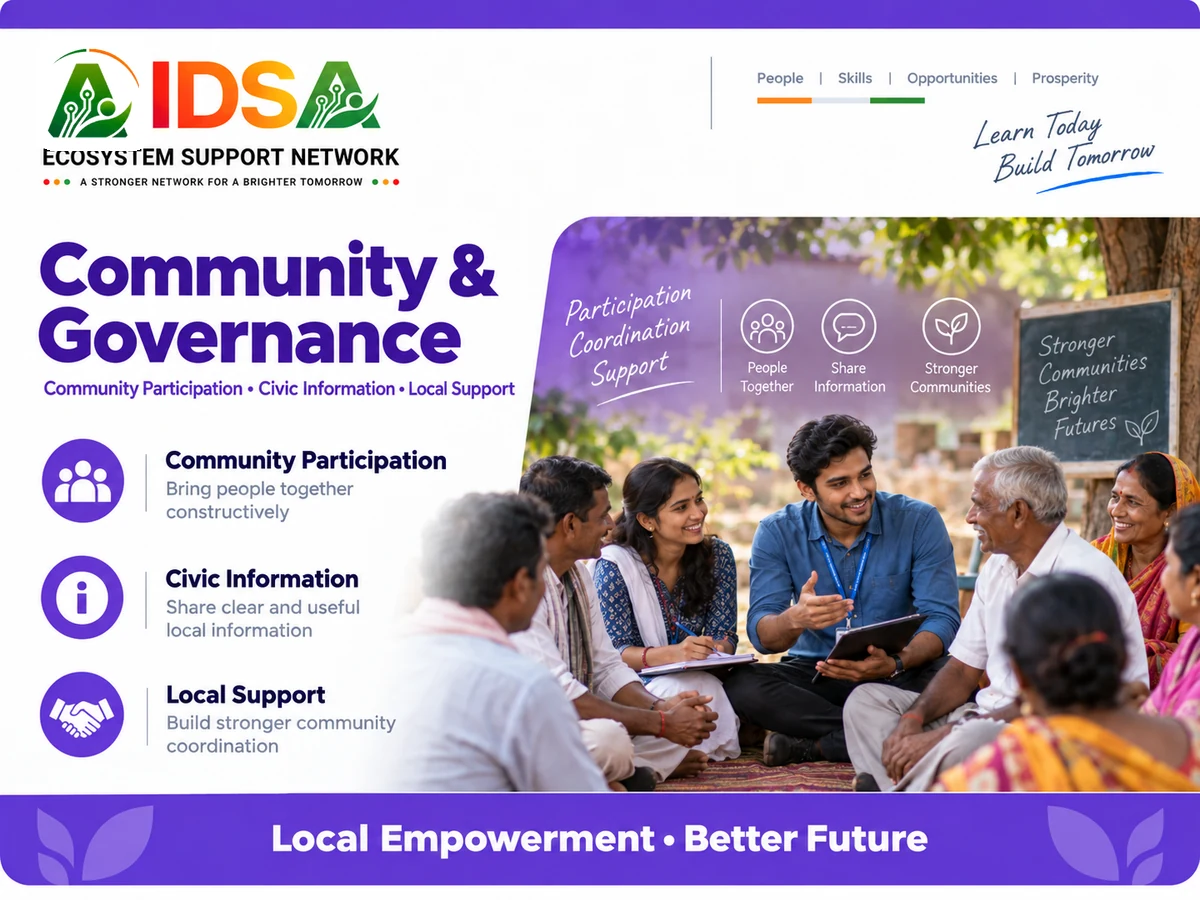
Participation • Coordination • Civic Information • Community Support
Strengthen community participation, clearer information and organised coordination while keeping official government authority separate.
Community & Governance is the coordination pillar of the IDSA Ecosystem Support Network. Communities work better when people know where to find information, how to participate responsibly and which organisation owns a particular decision. The pillar supports clearer communication and structured participation without presenting IDSA as a government department, Panchayat, regulator or statutory decision-making body.
Community needs are diverse. A village group may want information about a local programme, a business community may want to coordinate an event, a local support team may need to path a public request, and residents may want to understand which authority handles a civic issue. The ecosystem can help organise information and handoffs, but it should not create false authority or issue official approvals that belong to government or another institution.
Good governance in a private ecosystem also means transparency about roles. People should be able to understand whether they are speaking with an IDSA employee, partner, community volunteer, CSC operator, service provider or an external authority. Names, responsibilities and available actions should be clear enough that a user is not misled into believing a private representative has statutory powers.
Participation should be inclusive and practical. Community meetings, awareness activities, surveys, feedback, local problem identification and volunteer coordination can be useful when they have a clear purpose and respect privacy. Participation should not become pressure to join a business programme, political activity or financial scheme. People should be free to decide whether and how they engage.
Information quality is another important part of governance. Rumours, outdated notices and unsupported claims can create confusion quickly. Public communication should identify official sources where appropriate, use dates when information may change, and separate confirmed facts from future plans. When IDSA does not own the underlying authority, the correct approach is to guide users to the responsible source rather than rewrite official truth.
Community support can also help connect people to other ecosystem pillars. Someone may need education guidance, employment discovery, business support, a local digital-access path or an SOS coordination path. The Community & Governance pillar should make those handoffs clearer without duplicating the actual service. One connected ecosystem works best when each concern reaches the right owner.
The pillar therefore follows a simple principle: listen, organise, communicate clearly, identify the responsible owner, support lawful participation and keep a record where the programme requires it. IDSA can coordinate its own ecosystem and community programmes, while government functions, legal powers, official certificates and statutory decisions remain with the relevant public authorities.
Important: IDSA is a private ecosystem operator, not a government department or statutory authority, and does not issue government approvals.
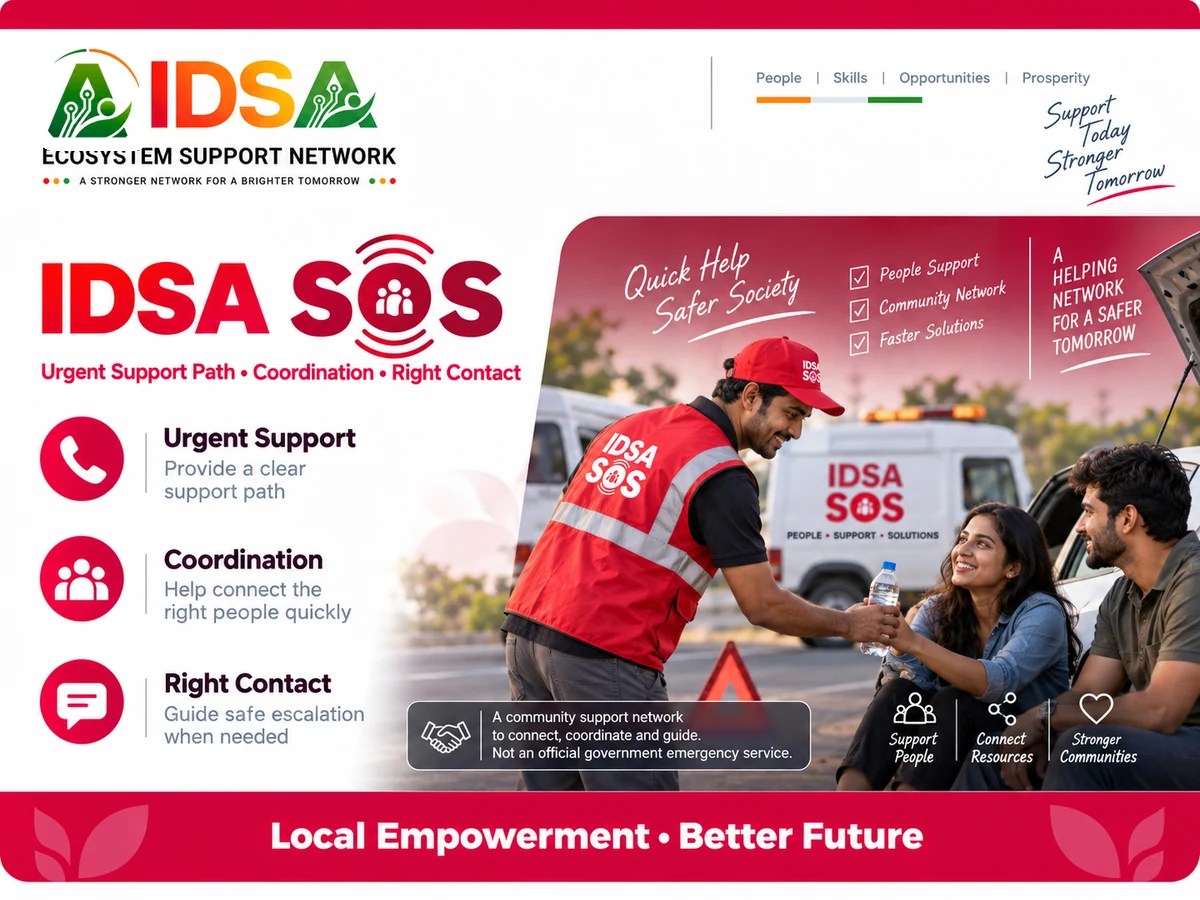
Urgent Support Path • Coordination • Right Contact
Provide a clear support and escalation path when applicable, while keeping government emergency response and life-safety services separate.
IDSA SOS is the support-and-coordination pillar of the IDSA Ecosystem Support Network. Its purpose is to help a person reach the right available support path when an issue needs urgent attention, follow-up or escalation inside the ecosystem. It is not a police service, ambulance service, fire service, government emergency control room or replacement for any statutory emergency authority.
The most important rule is urgency first. If there is an immediate threat to life, serious injury, fire, violence, major accident or another emergency requiring official response in India, the person should use 112 or the appropriate government emergency service immediately. Opening an IDSA ticket, sending a message or waiting for an ecosystem operator must never delay emergency action.
When the situation is suitable for IDSA coordination, the support path may help capture essential context, identify the relevant service or operator, record follow-up and guide the user toward the next available step. Examples may include a service problem, local support need, business or employment-related urgent issue, vehicle assistance context or another ecosystem concern where an approved support path exists.
Good SOS coordination depends on honest scope. A platform cannot promise that a responder will always be nearby, that a service provider will accept a case, or that an external authority will act in a particular way. Availability can vary by location, time, programme and the nature of the issue. The page should therefore explain the support path without presenting coordination as guaranteed rescue or guaranteed resolution.
Safety and privacy matter during an urgent situation. Users should share only the information necessary for the support request and should avoid posting sensitive personal data publicly. Location, contact or case details may be needed in a controlled support flow, but access should follow the applicable process. Operators should not ask for passwords, OTPs or unrelated sensitive information as a condition for basic support.
The SOS pillar can also act as a bridge to the rest of the ecosystem. A case may ultimately belong to a service provider, a workforce lane, a community support path, a business contact or an external emergency authority. The purpose is to reduce confusion and move the request toward the right owner. It should not create duplicate ownership for a service that already has a defined operational path.
IDSA SOS therefore follows a strict sequence: identify whether the situation is an official emergency, call 112 first when life or safety is at risk, use the IDSA support path only when appropriate, provide the minimum useful information, and follow the guidance of the responsible service or authority. Coordination can be valuable, but emergency authority and final service responsibility remain with the organisations that legally and operationally own them.
Important: IDSA SOS is a coordination/support platform, not a government emergency authority. For life-threatening emergencies in India, call 112 immediately.
Explore business, service, workforce, manufacturing, partner and district opportunities through the Opportunity Network, or use the related IDSA pathways for a specific need.
Availability, eligibility, review and operating rules vary by programme and location. No income, order, approval or service outcome is guaranteed.
One ecosystem. Local to global support.